
India's economy is estimated to contract by 9.6 per cent in the fiscal year 2020-21, reflecting a sharp drop in household spending and private investment, and the growth is expected to recover to 5.4 per cent in 2021, the World Bank said on Tuesday. In its Global Economic Prospects report, the World Bank said that the informal sector, which accounts for four-fifths of employment, has been subject to severe income losses during the COVID-19 pandemic.

India's economy is likely to grow by 6.5 per cent in the current and the next financial year, an EY report said, attributing lower than anticipated expansion in the September quarter to fall in private consumption expenditure and gross fixed capital formation. Real GDP growth eased to a seven-quarter low of 5.4 per cent in July-September -- the second quarter of the current 2024-25 fiscal year.

The Survey projected growth rate of 7-7.75 per cent for 2016-17 with downside risks due to weak global economic scenario.

Highlights of Economic Survey 2020-21, tabled in Parliament by Finance Minister Nirmala Sitharaman on Friday.

The growth was primarily driven by domestic investments, which accounted for 60 per cent of the total inflows during the first quarter of the financial year.

Foreign Portfolio Investors (FPIs) have pulled out over Rs 10,000 crore from Indian equities in the first three weeks of September, primarily due to rising US interest rates, recessionary fears, and overvalued domestic stocks. Before the outflow, FPIs were incessantly buying Indian equities in the last six months from March to August and brought in Rs 1.74 lakh crore during the period. Mayank Mehra, smallcase, manager and principal partner at Craving Alpha,believes that strong economic growth prospects, attractive valuations, and government reforms could support foreign investment flows in the next month.

Economist Deepak Nayyar says economic openness, while necessary, is not sufficient, and is conducive to development only when combined with industrial policy.

What stood out in his 15-year journey as a member of the political executive at the Centre was his glowing record as India's most successful and effective finance minister. Both as prime minister and finance minister, he understood the importance of gradualism, except when the economy or the polity was in a crisis.

'Why has Maharashtra slipped up over the past couple of decades?' 'Not only is this question critical for residents of the state, but given that it accounts for 14% of India's GDP, a faster-growing Maharashtra implies a faster-growing India as well, point out Shishir Gupta and Rishita Sachdeva.

Given the high priority accorded to the manufacturing sector, several policy initiatives around the theme of Atmanirbhar Bharat have been set in motion to address its competitiveness and growth. Some notable examples include the PLI scheme and the employment-linked incentive scheme announced in the recent Union Budget. The Budget also announced the setting up of 12 industrial parks under the National Industrial Corridor Development Programme (NICDP).

'For those looking at forward-looking signals for the economy from the stock markets, the relative performance of small and mid-caps may be a better indicator of the future than the index levels of the narrower and more popular indices', says Neelkanth Mishra.

'We emphasise the importance of not basing investment decisions solely on electoral outcomes.' 'Instead, focusing on investing in high-quality businesses capable of prospering regardless of the political landscape is paramount.'

For the first time, more than half of the CEOs surveyed by global consultancy PwC said they believe the rate of global GDP growth will decline. In comparison, the survey had found a record level of optimism among CEOs two years ago in 2018.

pbeat on the prospects of India's foreign trade contributing majorly to the economy, the Economic Survey on Wednesday cautioned against the negative impact of hardening of global oil prices and volatility among major currencies on country's exports.

Growth has slowed in some of the large emerging economies, its interim economic assessment report added. "One factor has been a rise in global bond yields -- triggered in part by an expected scaling back of the US Federal Reserve's quantitative easing -- which has fuelled market instability and capital outflows in a number of major emerging economies, such as India and Indonesia.

India and Russia on Tuesday set a target of $100 billion in annual trade volume by 2030 and vowed to develop a robust bilateral payment settlement mechanism using national currencies. The two sides also inked a total of nine agreements to further broadbase cooperation in a range of areas including in the economic domain following summit talks between Prime Minister Narendra Modi and Russian President Vladimir Putin.
Domestic policies rather than the global turmoil is what will really affect growth prospects.

The Opposition had promised to scrap the Dharavi redevelopment project if it came to power. With the Mahayuti's massive mandate in the Maharashtra assembly election, that prospect has been laid to rest.

The World Bank on Tuesday projected India's economy to grow at 8.3 per cent in 2021 and 7.5 per cent in 2022, even as its recovery is being hampered by an unprecedented second wave of the COVID-19, the largest outbreak in the world since the beginning of the deadly pandemic. The Washington-based global lender, in its latest issue of Global Economic Prospects released here, noted that in India, an enormous second COVID-19 wave is undermining the sharper-than-expected rebound in activity seen during the second half of Fiscal Year 2020/21, especially in services.

Argentina, Egypt, Ethiopia, Iran, Saudi Arabia and the United Arab Emirates have been invited to join the grouping.

Investors' wealth eroded by more than Rs 2.21 lakh crore in early trade on Wednesday, with the market witnessing a selling-off amid prospects of aggressive rate hikes by the US Federal Reserve to tackle high inflation, and sluggish global trends. In less than an hour of the start of trading on Wednesday, the key indices -- Sensex and Nifty -- were deep in the red and witnessed significant volatility, reflecting jittery investor sentiments. The market capitalisation of BSE-listed companies, which is also an indicator of wealth of investors, tumbled more than Rs 2.21 lakh crore to Rs 2,84,49,727.56 crore amid the 30-share Sensex falling 564.76 points to 60,006.32 points.
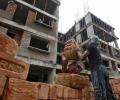
'We need to do more to accelerate growth.'

With nearly 100 countries closing national borders during the past month, the movement of people and tourism flows have come to a screeching halt. The contraction could be even higher if governments fail to provide income support and help boost consumer spending.
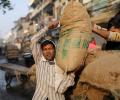
Against the Reserve Bank of India's (RBI's) projection of 7.1 per cent, India's first quarter (Q1) 2024-25 (FY25) gross domestic product (GDP) growth came in at 6.7 per cent. This is in line with market expectations and significantly lower than the 7.8 per cent recorded in the fourth quarter (Q4) 2023-24 (FY24) and 8.2 per cent in Q1FY24. The quarter witnessed decreased government consumption and investment spending due to the parliamentary election.

'The assessment of most people is that there is a stable economic and political environment in India and that is attractive to investors.'

Stock market investors became poorer by Rs 8.30 lakh crore as equities continued their slide for the sixth consecutive day on Friday. The BSE Sensex has tumbled 1,855.58 points or 3 per cent since February 16. During this period, the combined market capitalisation of BSE-listed firms has tanked Rs 8,30,322.61 crore to reach Rs 2,60,00,662.99 crore. "The domestic market is broadly demonstrating a lack of confidence, registering its sixth consecutive day of losses despite global markets turning green.
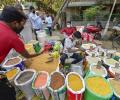
India's consumer price index (CPI)-based inflation could ease in the coming months thanks to the arrival of kharif crops, lower international commodity prices, and a pass through of lower input costs to consumers, the finance ministry said in its Monthly Economic Review (MER) for October, which was released on Thursday. The MER, however, warned that the global macroeconomic situation remained precarious and a recession in many advanced economies would impact India's exports. "Easing international commodity prices and new Kharif arrival are set to dampen inflationary pressures in the coming months.

Stressing that economic growth will only move upwards, the Reserve Bank of India Governor Shaktikanta Das on Friday pegged the GDP growth rate for the next financial year at 10.5 per cent, though a tad lower than the government's projection of 11 per cent. The projection is in line with the estimates in the Union Budget 2021-22 presented in Parliament earlier this week. The Economic Survey, tabled by the government in Parliament recently, has projected that the economy will grow at 11 per cent, up from an estimated historic decline of 7.7 per cent in 2020-21, on account of the COVID-19 pandemic.

Many believe that the surge in the markets defy economic reality and is being fuelled by aggressive monetary easing by central banks across the world.

Sensex ended strong, Tata Steel, HUL climb higher.

As a leader, he was ambitious, not for himself but for India and its people. His was not the short-term election cycle calculation of individual political gain. His was a practical vision of how to better the lives of his fellow citizens, asserts Ambassador Shivshankar Menon, who served as foreign secretary and national security advisor when Dr Singh was prime minister.

India's economic growth is expected to improve to 6.3 per cent in 2016 with the country leading economic recovery in South Asia, according to a United Nations report.

From highways connecting once-remote regions to aviation networks carrying millions, India's infrastructure story is one of transformation.
Facing a layoff is fast becoming more and more a real prospect for many professionals. To keep your job, you need to work smart not and do whatever it takes to make sure you are crucial to your company.

The growing decline of MTech applicants in Indian colleges is due to multiple factors, including outdated curricula, poor return on investment and lucrative non-engineering alternatives, say experts.

Global economy will have to grapple with few tough situations in 2015.

Indian economy is expected to grow at over 7.5 per cent, to overtake China.

Pratham Barot, CEO and co-founder, Zell Education, explains how specialised courses in finance can help you earn a cushy six-figure salary.
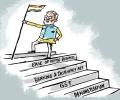
As the Ukraine conflict impacts the global GDP, India is projected to grow by 6.4 per cent in 2022, slower than the last year's 8.8 per cent but still the fastest-growing major economy, with higher inflationary pressures and uneven recovery of the labour market curbing private consumption and investment, according to a UN report. The UN Department of Economic and Social Affairs said in its World Economic Situation and Prospects (WESP) report released on Wednesday that the war in Ukraine has upended the fragile economic recovery from the pandemic, triggering a devastating humanitarian crisis in Europe, increasing food and commodity prices and globally exacerbating inflationary pressures. The global economy is now projected to grow by only 3.1 per cent in 2022, down from the 4.0 per cent growth forecast released in January 2022.

India's real GDP growth is set to exceed 7 per cent for CY-2015.
